
International
Juventus: Exor’s “No” sends the token crashing. Are Fans rejecting Elkann’s entrenchment?


The past weekend brought an unequivocal message from Turin: Juventus is untouchable. Or rather, it is not for sale—at least, not to Tether. Exor’s Board of Directors unanimously formalized the rejection of the offer, a stance vigorously reaffirmed by John Elkann. In a video message carrying the flavor of old-school moral suasion, the chairman invoked 102 years of family history, emphasizing that “our history and our values are not for sale.”
However, while traditional financial circles debate assets and valuations, another chart tells a very different story—one of disappointment and dissent: the Juventus Fan Token.
The Token Collapse: A Real-Time Fan Poll
While the Stock Exchange operates on balance sheets and long-term prospects, the Fan Token market (digital assets that do not represent equity but are widely held by supporters) acts as a seismograph for the mood on the street. And the verdict appears ruthless.
Riding the wave of enthusiasm over rumors regarding Tether’s entry and a potential change in corporate direction, the JUV token experienced a speculative spike, climbing to reach €0.89. It was a signal of hope: the hope for fresh capital and, perhaps, new management.
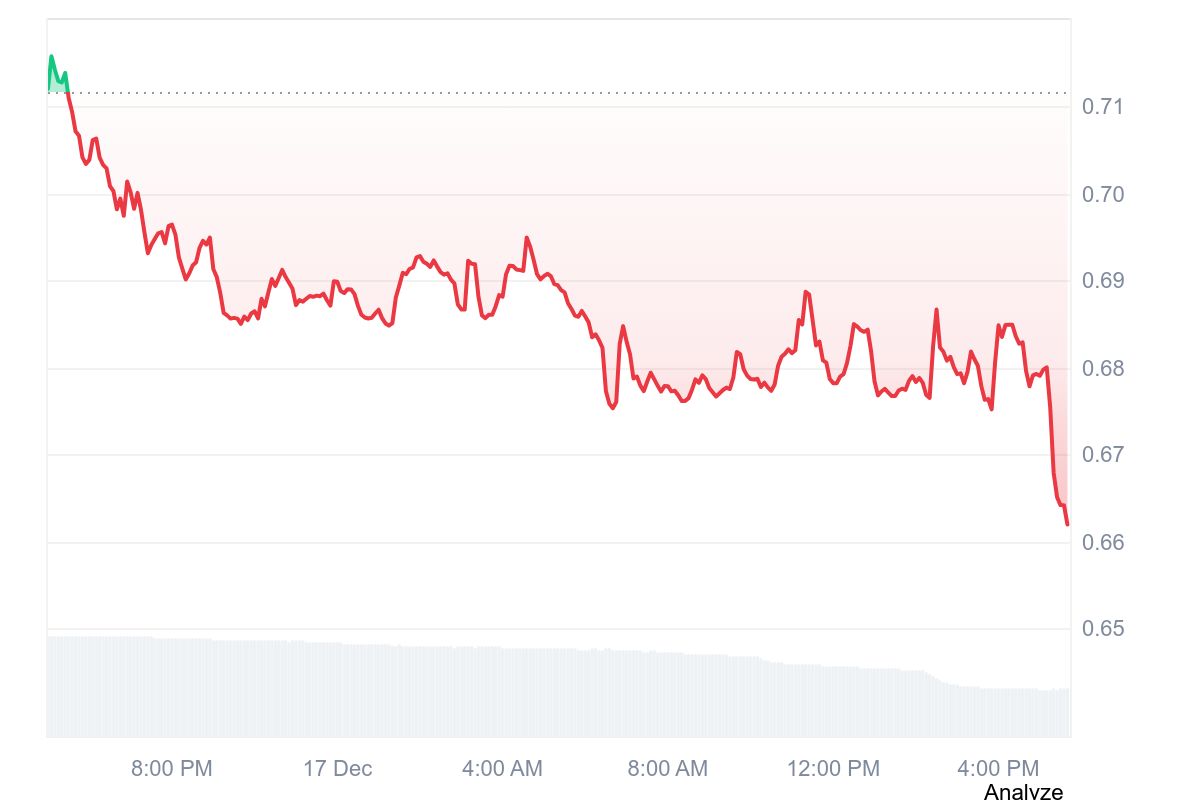
Exor’s response, arriving like a cold shower, abruptly reversed the trend. The value plummeted vertically, currently settling in the €0.65 range.
This drop of roughly 30% is not merely a technicality for crypto-speculators; it is a political indicator. The fans—or at least the digitally savvy segment investing in the token—do not seem to appreciate the Elkann family digging in their heels. The “emotional market” voted by selling, effectively expressing a vote of no confidence in the dynastic continuity in favor of a hypothetical revolution that never materialized.
The Battle of Valuations: Is €2 Billion Too Much?
Beyond the token, doubts remain regarding the fundamentals. Sources close to the Agnelli-Elkann holding company suggest that the refusal isn’t born solely of affection, but of a precise asset valuation. Exor estimates the club in the region of €2 billion. The benchmark used? Atlético Madrid, recently changing hands to Apollo Global Management for a figure close to €2.55 billion.
Exor’s logic is based on tangible fundamentals:
-
Infrastructure: The Stadium and the Continassa complex are worth, according to internal estimates, between €450 and €600 million.
-
Intangible Assets: The brand heritage and the fan base.
Here, however, the math risks not adding up. If Atlético is worth that much and Real Madrid trades at higher multiples, Juventus suffers from a real fanbase gap that could make the €2 billion request excessive.
The War of Numbers: How Many Fans Are There, Really?
While some optimistic research speaks of 560 million Bianconeri fans globally, data provided by Sisal paints a very different and decidedly less “global” reality. If a club’s value is directly proportional to its ability to monetize fans worldwide, Juventus struggles to keep pace with the English and Spanish giants.
Here is the ranking of the top 15 clubs by number of fans (Sisal Data), which scales back the Torinese ambitions:
| Rank | Team | Fans (Millions) |
| 1 | Manchester United | 650 |
| 2 | Barcelona | 450 |
| 3 | Real Madrid | 350 |
| 4 | Chelsea | 145 |
| 5 | Arsenal | 125 |
| 6 | Manchester City | 110 |
| 7 | Liverpool | 100 |
| 8 | AC Milan | 95 |
| 9 | Inter Milan | 55 |
| 10 | Bayern Munich | 45 |
| 11 | PSG | 35 |
| 12 | Tottenham | 35 |
| 13 | Juventus | 27 |
| 14 | Borussia Dortmund | 22 |
| 15 | AS Roma | 22 |
With only an estimated 27 million fans compared to Real Madrid’s 350 million or United’s 650 million, the claim for a monster valuation appears difficult to justify. Even the Continassa real estate, however precious, risks being an illiquid asset if the team underperforms: a property like any other, the value of which depends on the “circus” surrounding it.
The suspicion remains that Elkann’s position is also dictated by a sort of “spite” or dynastic pride: selling now would mean admitting a managerial defeat. But the JUV token chart suggests that the fans would have preferred to turn the page.
Q&A
What does the JUV Token crash indicate after Exor’s refusal?
The JUV Fan Token, while not representing corporate equity, serves as a sentiment indicator for the fanbase. The drop from €0.89 to €0.61 (approx. 30%) immediately following the “no” to Tether signals strong disappointment among fans. It can be interpreted as a lack of confidence in the continuity of the Elkann management and a frustrated desire for a change in ownership that fans hoped would bring fresh liquidity.
Why does Exor value Juventus at €2 billion?
Exor’s valuation is based on comparisons with recent sales of European clubs (such as Atlético Madrid at €2.5 billion) and the value of proprietary real estate assets (Stadium and Continassa), estimated between €450 and €600 million. The family believes that the heritage and history justify a premium price, despite analysts’ doubts regarding the actual size of the global fanbase compared to top English and Spanish clubs.
Do the fan statistics justify the price asked by the Agnelli family?
Independent data (such as that from Sisal) suggests caution. With an estimated 27 million fans, Juventus ranks 13th globally, far behind Manchester United’s 650 million or Real Madrid’s 350 million. Since modern commercial value depends on monetizing the fanbase, there is a discrepancy between the €2 billion request and the comparative fundamentals with the European “Elite.”


Juventus between Saudi Sirens and the Shadow of Tether: Exor resists the €2 Billion, but the Market bets on weakness

Russia, a Bitter Start to 2026: Oil Revenues Plunge 50%. Global Prices Will Decide the Budget’s Future

Juventus: Exor’s “No” sends the token crashing. Are Fans rejecting Elkann’s entrenchment?

Not just offshoring: the revival of genuine Made in Italy jeans (handmade in Veneto)
